OCI Enterprise AI works in four steps for developers building AI solutions. First, teams choose the foundation model or models that best fit their use case and performance needs. Next, they connect the agent to enterprise data and knowledge sources to ground responses, including structured systems and vector search–based retrieval for unstructured content. Then developers define the agent workflow: what tools and APIs the agent can call and how it orchestrates multistep actions and conversation context to complete tasks. Finally, developers deploy and operate the agent in production with built-in controls, including identity and access management–based access control, guardrails, observability, and auditability for secure, reliable enterprise use.
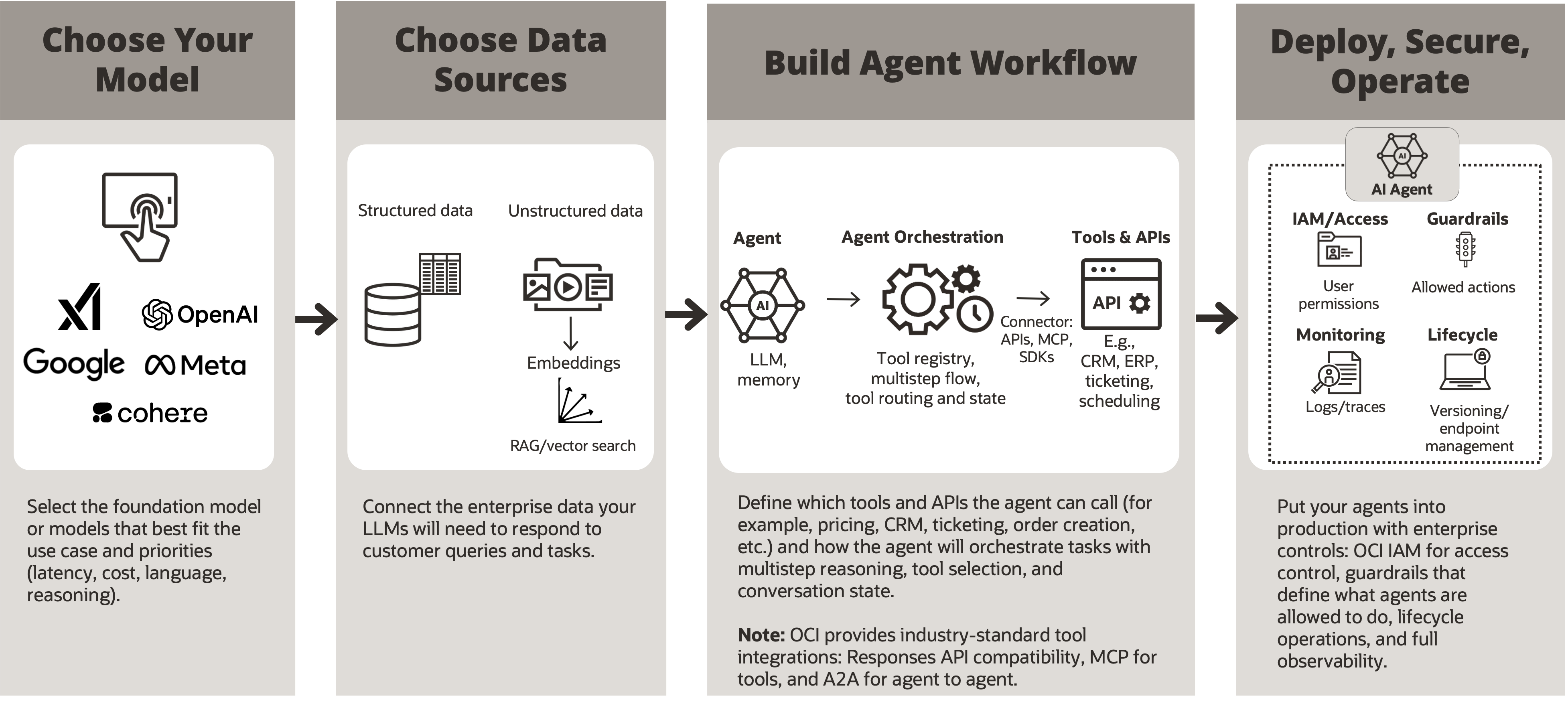
Diagram illustrating four steps for building an OCI Enterprise AI solution: choose the best-fit foundation model, connect the agent to enterprise data and knowledge sources (including vector-search retrieval for unstructured content), define the agent workflow and tool/API calls, then deploy and operate in production. Built-in controls are highlighted, including IAM-based access control, guardrails, observability, and auditability for secure, reliable use.